13 Key New Laws You Need to Know in Idaho. Plus the Bills That Didnt Make It
A pecker that bans transgender girls and women from participating in girls' and women's sports has apace spread to more than 30 statehouses across the country subsequently originating in Idaho.
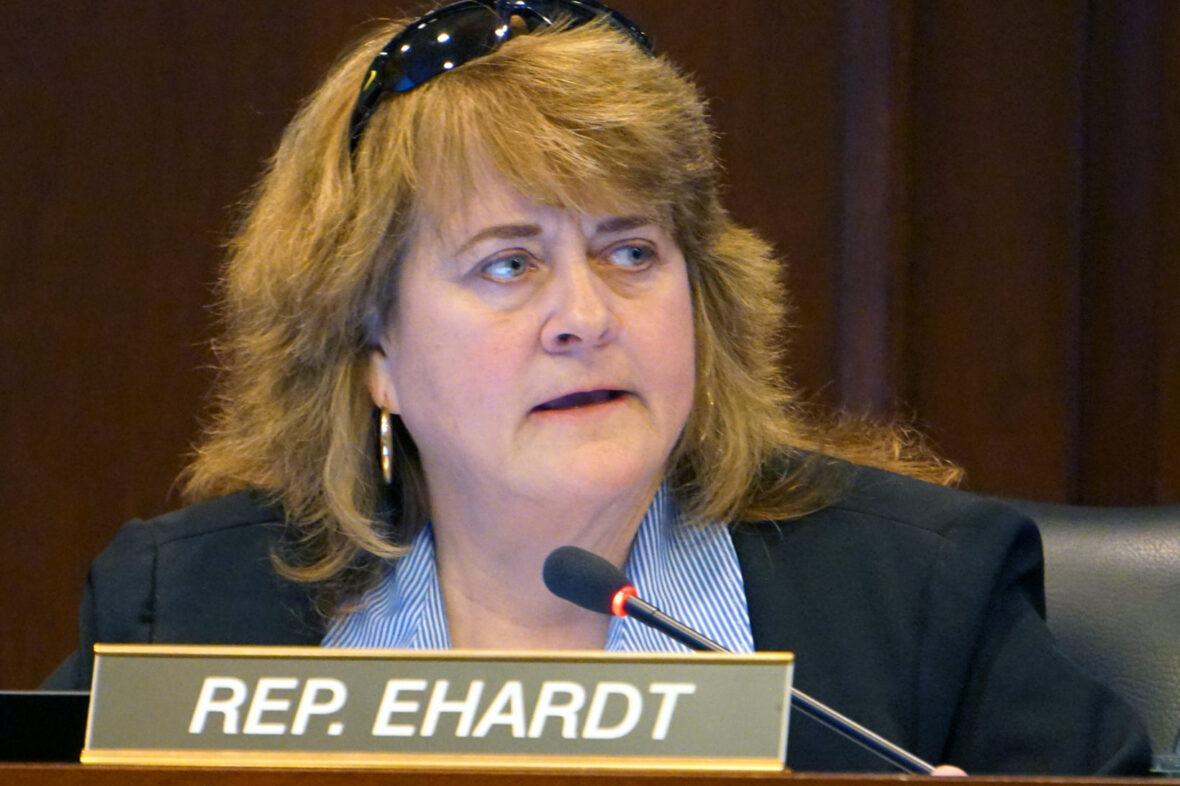
Sponsored by Rep. Barbara Ehardt, R-Idaho Falls, the bill originated in the form of House Bill 500 during the 2020 Idaho legislative session. The Republican supermajority that controls the Legislature passed it, and GOP Gov. Brad Little signed it into police force.
While states beyond the U.Due south. have picked upwardly a version of the bill this year, U.S. District Court Judge David Nye issued an injunction last summer putting Idaho'due south law on hold while a lawsuit over the constitutionality of the law plays out.
Hearings are expected to resume in U.South. District Courtroom in May.
Ehardt, a old Idaho Land University basketball player who coached at Cal State-Fullerton, Brigham Young University and Washington Land University, said the bill is virtually protecting opportunities for women to play sports and preserving gains made nether the federal Title Ix law. Without it, Ehardt said students who are assigned male at birth but place as a woman would be able to take women's spots and dominate competition.
"There accept been many women who paved a path forward for me, nigh of whom I never even knew," Ehardt said in a March 24 telephone interview. "I felt it was incumbent upon myself to do the aforementioned for girls and women to follow."
But opponents say the beak discriminates against transgender women and could subject immature student athletes to invasive physical examinations if their assigned sexual practice at nativity is challenged.
"Unfounded stereotypes and false scientific claims led to the passage of HB 500 and are embodied within it," ACLU Idaho and Legal Voice wrote in an Apr 2020 lawsuit over the Idaho law.
"In curt, HB 500 is entirely unnecessary, was prompted past a campaign targeting transgender and intersex persons and can exist explained only as impermissible and baseless bigotry."
Chelsea Gaona-Lincoln said it has been hard to lookout the pecker pass in Idaho and advance to other states. Gaona-Lincoln is the Idaho programs manager for Legal Vocalization, a nonprofit Northwest business firm working for equality and the protection of rights for the LGBTQ customs and women.
Legal Voice joined ACLU Idaho in suing over Idaho's law last year.
Gaona-Lincoln said these bills and bans create a standard of othering and erasure against young people who are just trying to belong and find a supportive home in sports and at school.
"That erasure is and then deeply painful and so deeply troubling," Gaona-Lincoln said in a telephone interview. "Y'all can't legislate people out of existence, merely you can create a lot of harm in doing that."
Gaona-Lincoln ran unsuccessfully for the Idaho House as a Democrat in Canyon County in 2020.
Ehardt enlisted help from Alliance Defending Freedom, other groups
Ehardt said she came up with the basics of the thought that became HB 500 in 2018 when she heard about high school state track meets in Connecticut that 2 transgender girls won.
"I thought that was wrong; biological boys should non compete against biological girls," Ehardt said. "I realized if we don't practise something nigh this, nosotros all see where this is heading."
Ehardt, who was first appointed to the Legislature in December 2017, contacted Idaho Legislative Services Office for assist drafting her idea into bill grade. She said it was 1 of the first bills she began working on.
At commencement, Ehardt said she couldn't figure out how to go the nib off the ground. So she said she began reaching out to as many as 12 to 15 conservative groups focused on "traditional family unit values" for aid and direction.
"I contacted somebody at the (Brotherhood Defending Freedom) and the one affair they helped me find is at that place was a path forrard through the Idaho Legislature," Ehardt said.
One of the original roadblocks Ehardt faced is she didn't remember the Legislature could write policy for the Idaho High Schoolhouse Activities Association, which is a private group. But she said somebody at the Alliance Defending Freedom found House Beak 632 from the 2012 legislative session, a law that set out new concussion, caput injury and return-to-play protocols that applied to center school, junior high or loftier schoolhouse sports, including those overseen by the Idaho High School Activities Association.
That precedent, Ehardt said, was her foot in the door and ticket forward.
At that point, Ehardt reached back out to the alliance'south legal counsel to expect it over and advise alterations.
"That'due south where the Alliance Defending Freedom decided to get involved and help arts and crafts some better legislation," Ehardt added.
Legislation modeled past Alliance Defending Freedom helped bill spread
Ehardt credited the Alliance Defending Freedom with helping spread the neb they worked on together from state to country via model legislation, where the substance of a bill remains the same, but sure language — such every bit the name of the state — is changed.
The Alliance Defending Freedom is an Arizona-based 501(c)(three) nonprofit that focuses on advocacy, training and funding legal cases. According to its website, it focuses on the problems of "religious liberty, sanctity of life and marriage and family unit."
Southern Poverty Law Eye classifies Alliance Defending Freedom, or ADF, every bit an anti-LGBTQ hate group.
"Since the election of President Trump, ADF has get one of the nearly influential groups informing the administration's assault on LGBTQ rights," SPLC officials wrote in their file for the alliance.
Matt Sharp, senior counsel for Brotherhood Defending Liberty, said the ADF disagrees with Southern Poverty Law Center'south nomenclature. He called it a fundraising tactic.
"We are very disappointed in SPLC'due south attack against organizations like Alliance Defending Liberty that are standing upwards for female athletes, standing up for religious freedom and standing upwardly for free speech," Sharp said in a telephone interview.
The brotherhood'south website has a tab devoted to fairness in women's sports promoting "a large collation of athletes, legislators, governors, attorneys general grade xiv states and many others (that) have been honored to stand up up for women'due south sports in courts and legislatures across the canton."
State legislators across the country take reached out or worked with the alliance for guidance and have used Idaho's law as a template for their own bills, Precipitous said.
"You see the Idaho law really beingness used equally a model that other states have taken, usually verbatim," Sharp said. "To put that on their books sometimes you lot have to arrange to comply with a particular land's code and how they phrase things."
Alliance for Defending Freedom is involved in the Idaho lawsuit, Precipitous said. ADF is also involved in lawsuits in Connecticut stemming from the track meets that Ehardt said inspired her bill in the first place.
Idaho legislator travels to other states to support student athlete bills
Ehardt is also supporting the beak's passage in other states.
This year, she said she traveled to Montana and Due south Dakota to testify in favor of similar bills in those states. Ehardt likewise testified or has plans to evidence in front of several other state legislatures remotely, she said.
When she travels to prove on those bills, Ehardt said she doesn't expense the trip to either state's taxpayers.
"It's not state money," Ehardt said. "Pro-family unit groups, both times, paid for it. From that state."
The Idaho Upper-case letter Sun requested Idaho legislators travel and expense reports for the 2021 session in March and found Ehardt did non expense any of her out-of-country trips. She declined to name the specific groups that covered her costs.
In each example, Ehardt said somebody reached out to her and asked for testimony; she said she didn't proactively attain out to legislators in other states.
South Dakota'south Legislature passed a similar bill to Idaho's in March. Although the bills themselves are unlike, the key department of Idaho and S Dakota's bills are similar.
Idaho'southward HB 500 reads: Able-bodied teams or sports "shall be expressly designated every bit i of the following based on biological sexual activity:
- A) Males, men or boys;
- B) Females, women or girls; or
- C) Coed or Mixed
- Able-bodied teams or sports designated for females, women or girls shall not be open up to students of the male sex."
South Dakota's HB 1217 reads: any athletic squad or sport "must be expressly designated as being:
- A male team or sport;
- A female squad or sport; or
- A coeducation team or sport.
A squad, or sport designated as being female is bachelor only to participants who are female, based on their biological sexual activity, as verified in accordance with subsection 13-67-two."
Both bills also accept the phrase "fairness in women'due south sports" in the championship of the legislation.
What is model legislation and who uses it?
Jaclyn Kettler, an assistant professor of political science at Boise State University, said using model legislation or class legislation is one tactic advocacy groups and policymakers on both sides of the political aisle utilise to share legislation between states.
In simplified terms, model legislation could exist idea of as a generic pecker template where a few words or legal citations could be swapped out and the real substance of the pecker could be dropped off at a statehouse in Idaho, Iowa or Ohio for introduction.
A proliferation of stand-your-ground laws a few years ago was one case of model legislation, Kettler said.
The transgender athlete bans are the latest.
It can exist extremely difficult for the public to tell if bills originated via model legislation or if they came about more organically. One tool political scientists accept been using is anti-plagiarism software that will flag matches in different bills across different states. Kettler said this is becoming easier as engineering advances.
"Model legislation isn't annihilation new, there have been groups or organizations providing model legislation for a long time," Kettler said. "ALEC (the American Legislative Substitution Quango) has gotten a lot of attention from reporters and scholars in terms of how successful they take been in terms of getting model legislation introduced and passed in many state legislatures, especially in those more conservatives legislatures."
In retrospect, there were plenty of signs Ehardt'southward nib, controversial equally information technology is, was about to blow upwardly on the national stage.
In June 2020, former Chaser General William Barr filed a statement of interest from the Trump Administration supporting Idaho'south law banning transgender athletes.
Then, in Nov, Nebraska Attorney General Doug Peterson and xiii other Republican attorneys general signed a friend of the court brief supporting Idaho's law, the Post Register reported .
"It'due south been pretty exciting and very gratifying to see something I started working on in the fall of 2018, to see that get-go to come up to fruition, obviously non just in Idaho, but in so many other states," Ehardt said.
Idaho Capital Sun is function of States Newsroom, a network of news bureaus supported by grants and a coalition of donors as a 501c(iii) public clemency. Idaho Majuscule Sun maintains editorial independence. Contact Editor Christina Lords for questions: [email protected] Follow Idaho Capital Sun on Facebook and Twitter.
Republish this article on your website
Source: https://www.idahoednews.org/news/30-u-s-states-now-considering-version-of-idahos-transgender-athlete-bill/
0 Response to "13 Key New Laws You Need to Know in Idaho. Plus the Bills That Didnt Make It"
Post a Comment