Handmade Hard Leather Black Bag With Tan Lace Like They Make in High School Art Classes
Fish skin may await frail, simply leather produced from it is stiff and pliable. Photo by Kathleen Hinkel
The Art of Turning Fish into Leather
Fish peel leather was one time mutual in angling communities; now artisans and designers are breathing new life into the tradition.
Commodity body copy
Tracy Williams slaps a plastic cutting board onto the dining room tabular array in her home in North Vancouver, British Columbia. Her friend, Janey Chang, has already laid out the materials we will demand: spoons, seashells, a stone, and snack-sized ziplock bags filled with semi-frozen fish. Williams says something in Squamish and and so translates for me: "Y'all are ready to make fish pare."
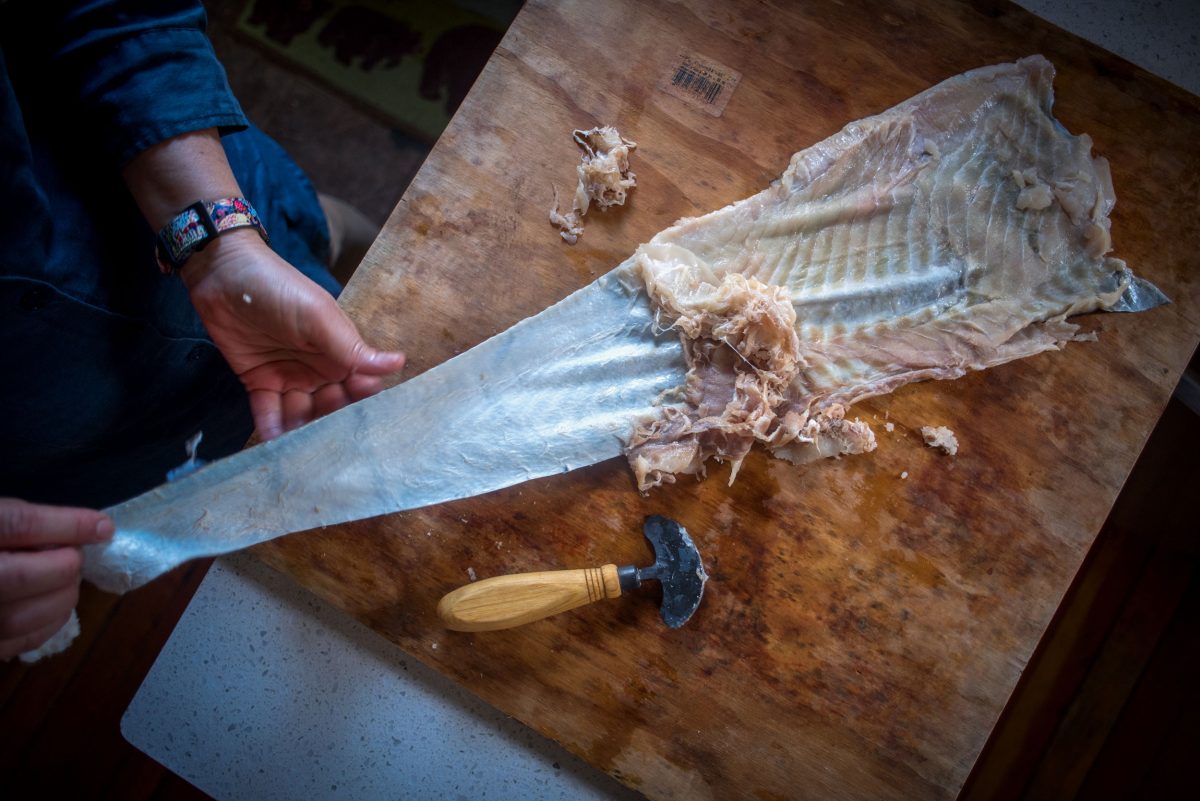
Chang peels a folded salmon skin from one of the bags and flattens it on the tabular array. "You can actually have at her," she says, demonstrating how to use the border of the stone to rub away every fiber of flesh. The scales on the other side of the skin will have to get, likewise. On a sockeye skin, they come off hands if scraped from tail to head, she adds, "similar rubbing a true cat backwards." The skin must be clean, otherwise it will rot or fail to absorb tannins that will assist transform it into leather.
Williams and Chang are ii of a scant but growing number of people who are rediscovering the craft of making fish skin leather, and they've agreed to teach me their methods. The two artists have spent the past five or six years learning almost the craft and tying it back to their singled-out cultural perspectives. Williams, a member of the Squamish Nation—her bequeathed name is Sesemiya—is exploring the craft through her Indigenous heritage. Chang, an ancestral skills teacher at a Squamish Nation schoolhouse, who has also begun teaching fish skin tanning in other BC communities, is linking the craft to her Chinese ancestry.
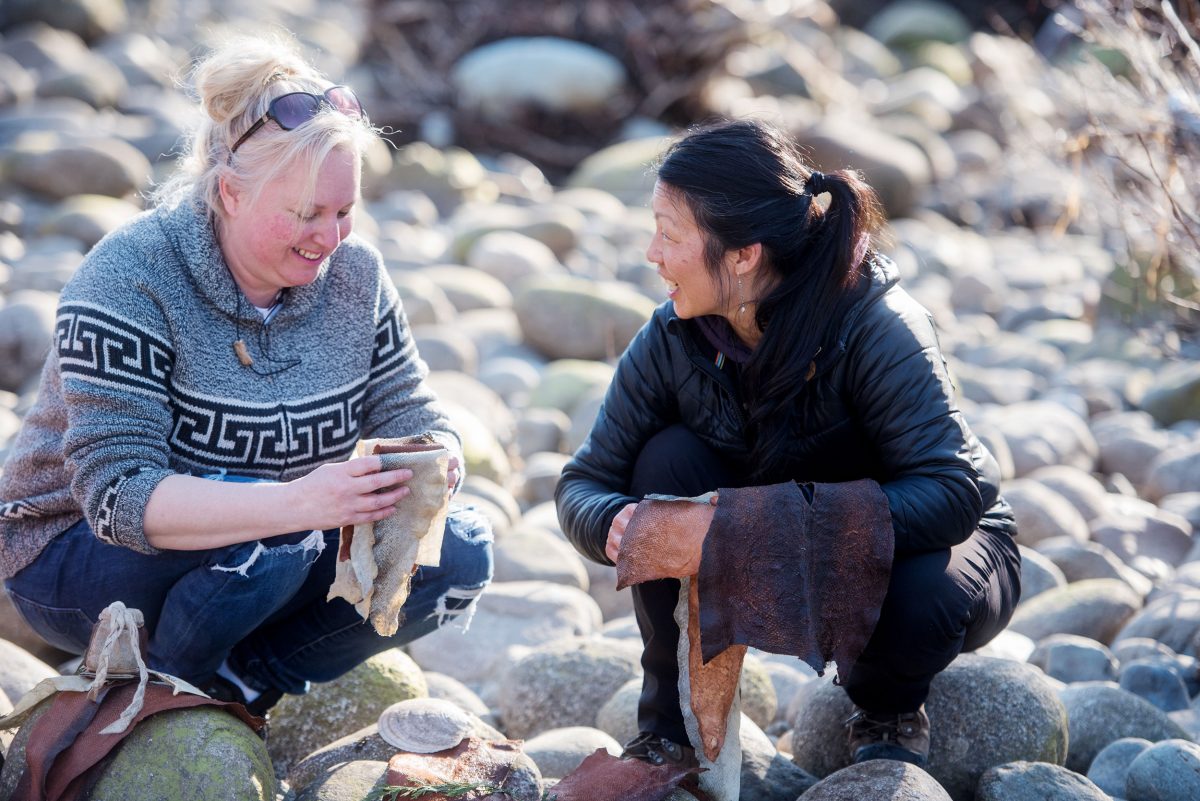
Friends Tracy Williams (left) and Janey Chang procedure salmon skins along the Seymour River in North Vancouver, British Columbia, behind the Squamish Nation's offices where Williams works. Photograph by Kathleen Hinkel
Fish skin leather used to be commonplace in many cultures. It was similar an early on form of Gore-Tex. Now, information technology's making a improvement. Fish skin leather is likewise emerging as a article in the world of way; in recent years, the material has caught the eye of designers who want to incorporate it into luxury items. Other eco-minded entrepreneurs are drawing inspiration from traditional tanning techniques to find alternate, sustainable means of making leather. With its revival, the craft offers opportunities to reflect on old ideas that are still relevant to modern life.
Earlier the ascent of manufactured fabrics, Indigenous peoples from coastal and riverine regions around the world tanned or dried fish skins and sewed them into clothing. The material is strong and water-resistant, and it was essential to survival. In Nihon, the Ainu crafted salmon pare into boots, which they strapped to their feet with rope. Forth the Amur River in northeastern China and Siberia, Hezhen and Nivkh peoples turned the fabric into coats and thread. In northern Canada, the Inuit made clothing, and in Alaska, several peoples including the Alutiiq, Athabascan, and Yup'ik used fish skins to fashion boots, mittens, containers, and parkas. In the winter, Yup'ik men never left abode without qasperrluk—loose-plumbing equipment, hooded fish skin parkas—which could double every bit shelter in an emergency. The men would prop up the hood with an ice pick and pin down the edges to make a tent-like construction.
Equally practical and pervasive as the material was, the practice of making fish skin leather faded in the 20th century. Its loss is intertwined with colonialism and assimilation. In 1899, Japan enacted the Hokkaido Erstwhile Aborigines Protection Act, which clinched the assimilation of Ainu people into Japanese society—the Ainu lost their lifestyle of angling, hunting, and gathering. In Alaska, Indigenous peoples were get-go forced into slave labor by Russian fur hunters and subsequently subjected to US policies aimed at eradicating their traditional lifestyles. Handmade fish skin clothing gave way to rubber boots and factory-made rain gear. Equally fish skin leather slipped into obscurity, so did the knowledge of how to produce it.

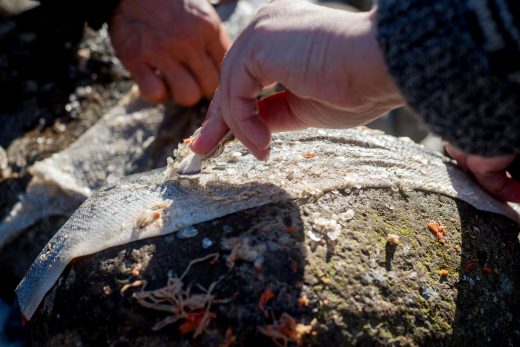
Forth the Seymour River, Williams and Chang first soak their salmon skins and then apply seashells to scrape away the scales as role of their tanning process. The women say that working outside with materials plant in nature enhances the feeling of connectedness that they get from making fish leather. Photo past Kathleen Hinkel
In British Columbia, the textile's history is less clear. In the belatedly 1800s, ethnographer James Teit recorded Indigenous peoples' use of the cloth in the southern interior of the province: some members of the Nlaka'pamux made shoes out of dog salmon (chum) skins and part of the St'át'imc Nation fashioned fish skin sandals, repeatedly smearing the soles with pine or fir mucilage mixed with sand or earth to brand them thicker and harder. Farther north, the Tsilhqot'in made fish peel bags. Evidence from other cultures has largely disappeared, if it existed. Fish pare doesn't preserve well archaeologically so its history in the province is poorly understood, says Brian Hayden, professor emeritus of archeology at Simon Fraser University in British Columbia.
Fish skin leather was non part of Williams's upbringing, and she has however to detect evidence that her Squamish ancestors worked with fish skins, though she suspects information technology may just not have been documented. It's also possible that the material's history was overlooked or forgotten considering of its reputation. Williams's in-laws from the inland Líl̓wat Nation recall fish skin shoes, merely were reluctant to talk to her about it at first. Fish skin shoes were considered the poor man's shoes. Similarly, in Alaska, fish pare parkas take sometimes been referred to as "poor people's raincoats," since even unskilled hunters could usually catch fish.
Williams and Chang embraced fish skin without reservation. They first heard about the material at a gathering in Washington State focused on bequeathed skills. The two have known each other for almost 20 years, connected by a shared involvement in living off the land. At the Washington gathering, they took a workshop together where they learned to tan salmon skin. "I was enamored with it," Williams says.
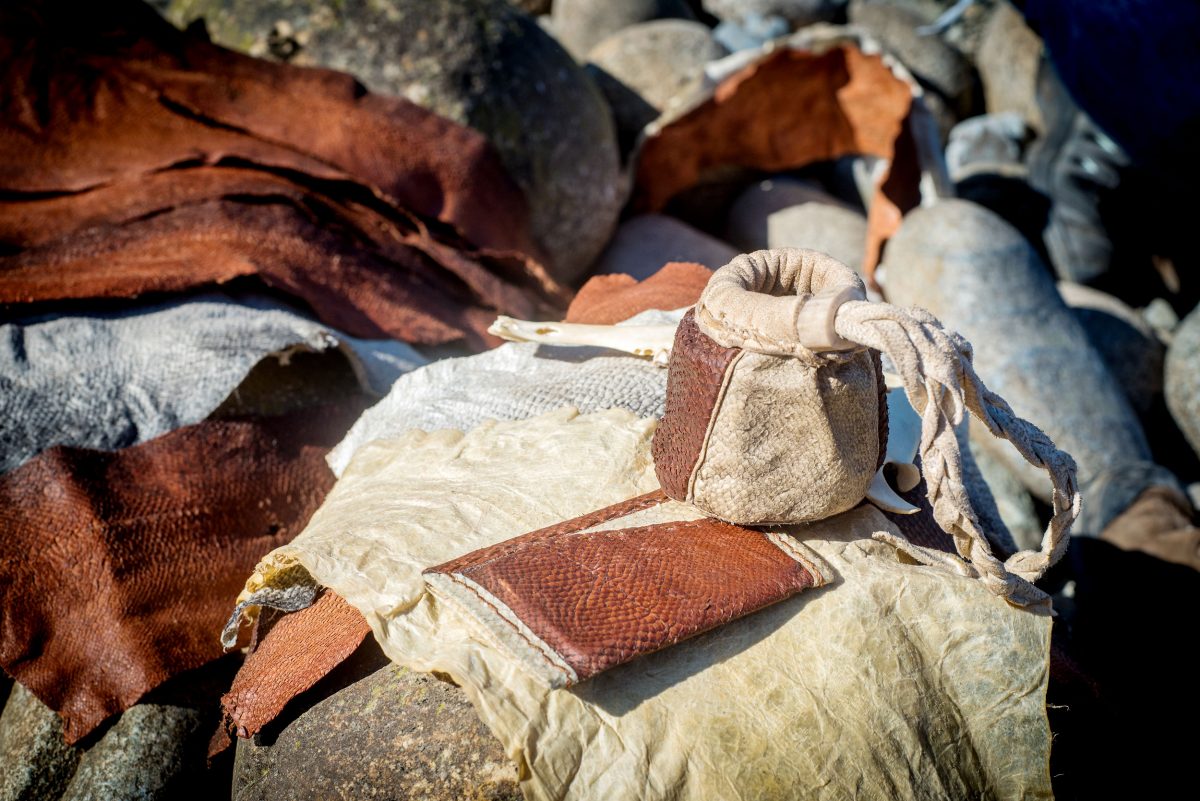
Williams and Chang have crafted several functional items out of their tanned fish skin leather, including this wallet and bag that Chang made from salmon. Photograph past Kathleen Hinkel
Since then, she has been learning more about the arts and crafts by piecing together scraps of information from books, scouring the internet, talking to other tanners, and experimenting with recipes at dwelling house. She and Chang accept tried tanning with coffee, black tea, and even an egg and oil mixture. Chang has also experimented with alder bark and wine. While they don't e'er tan together, Williams and Chang often consult each other to troubleshoot. The learning curve has involved many failures, they say. Their offset try with coffee left the skins crispy; red wine made them slap-up. Williams tried tanning with urine, a technique historically used past Indigenous communities in Alaska. She paid Chang's son ane dollar for each jar he filled—but the skins disintegrated when bathed in the liquid.
Despite the flops, there have been successes. Williams appliquéd fish leather on a pair of deerskin shoes she made. Chang has made pouches with alternating panels of fish and buckskin and crafted a wallet out of bark- and oil-tanned fish leather. These are hard-earned achievements, the result of years of trial and mistake and hours upon hours of labor for each skin.
On a Saturday morning, I visit Aurora Skala in Saanich on Vancouver Island, British Columbia, to learn about the step afterwards scraping and tanning: softening. Skala, an anthropologist working in linguistic communication revitalization, has taken an involvement in making fish pare leather in her spare time. When I get in at her house, a salmon skin that she has tanned in an acorn infusion—a cloudy, brownish liquid now resting in a jar—is stretched out on the kitchen counter, ready to be worked.
Skala dips her fingers in a jar of sunflower oil and rubs it on her hands before massaging it into the pare. The peel smells only faintly of fish; the aroma reminds me of table salt and smoke, though the skin has been neither salted nor smoked. "Once you start this process, y'all can't cease," she says. If the pare isn't worked consistently, information technology will stiffen every bit it dries.
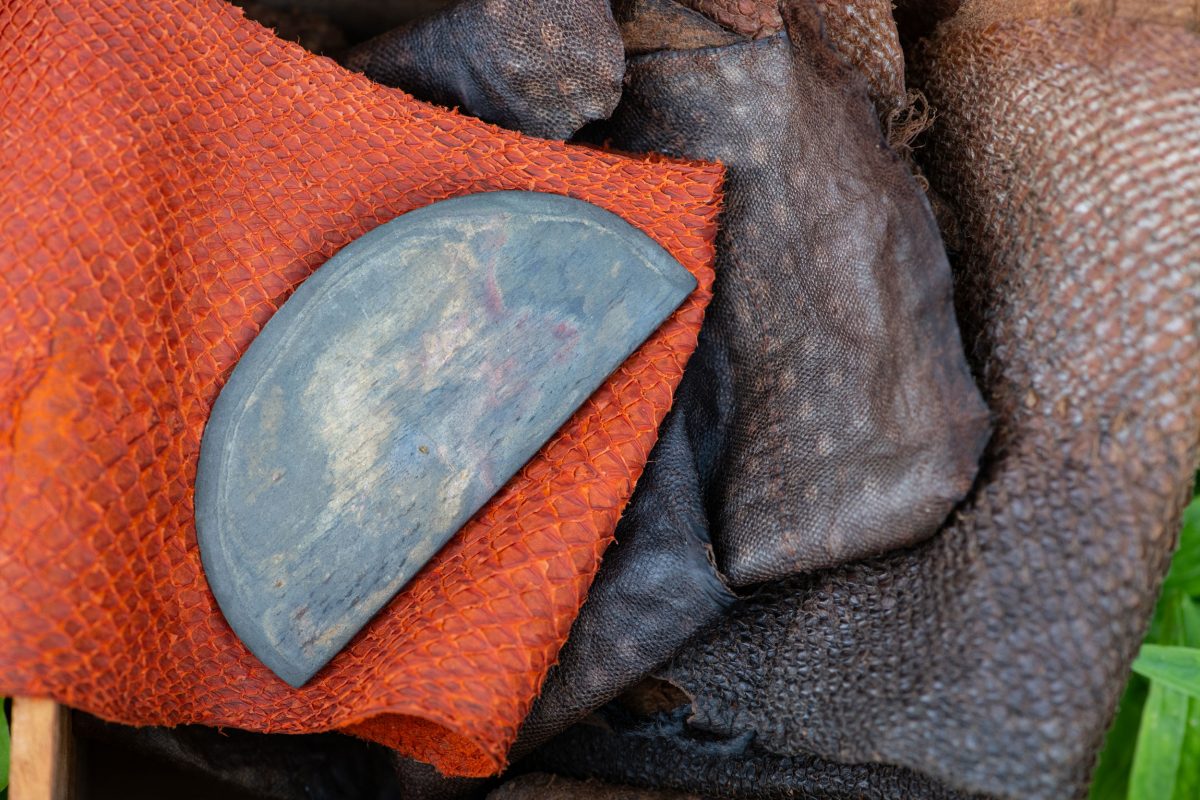
A close-up view of a scraping tool and a few tanned fish skins owned by artisan Aurora Skala. Photo by Shanna Baker
Softening the leather with oil takes about 4 hours, Skala says. She stretches the skin between clenched hands, pulling information technology in every direction to loosen the fibers while working in pocket-size amounts of oil at a time. She'll also work her skins across other surfaces for extra softening; later, she'll accept this piece outside and rub information technology back and along forth a metal cable attached to a telephone pole. Her pace is steady, unhurried, soothing. Back in the 24-hour interval, people likely made fish pare leather aslope other chores related to gathering and processing food or fibers, she says. The skin will be done when it's soft and no longer absorbs oil.
Skala's interest in fish pare leather is as much academic as it is artistic, she says; learning well-nigh the craft has given her a deeper appreciation for the ingenuity and adaptability of by communities. She considers her piece of work to be an informal version of experimental archæology, a field of study that involves replicating ancestral tools and skills to better understand how they were made and used. One tin can learn a lot near ancestral skills by using them firsthand.
In Alaska, a like mindset has shed light on fish pare items in museum collections. During the 19th century, museum collectors were more interested in accumulating artifacts than investigating how they were made, says Aron Crowell, Alaska director of the Smithsonian Institution's Arctic Studies Center in Anchorage. At the time, broader guild believed Indigenous cultures were dying, and museum collectors rushed to preserve what they could. Equally a effect, fish skin objects in museums are often defective documentation.
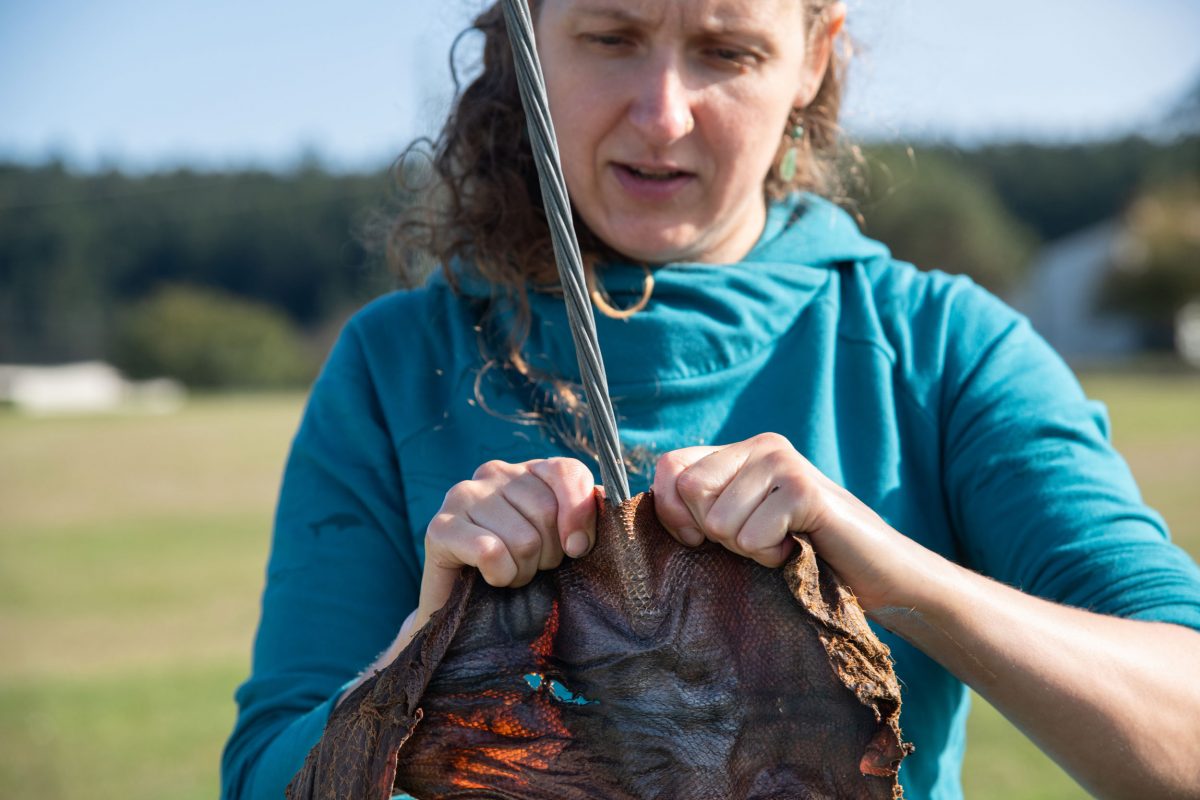
Skala works a piece of fish skin across a cablevision outside her home in Saanich, British Columbia, to soften it. Photo by Shanna Baker
To make full in knowledge gaps and to give young artists a learning opportunity, the Arctic Studies Center hosted a five-mean solar day workshop in 2012 at which Yup'ik, Sugpiaq, and Koyukon Athabascan artists demonstrated the total process of making fish peel leather items. Museum workers gained insight on how to restore and intendance for fish leather. They even learned that a certain sew together is h2o-resistant when combined with a specific fashion of folding seams, but is not impermeable, as they had thought. This distinction, Crowell says, adds to a more than nuanced understanding of the arts and crafts.
The exchange of information has gone both ways. Fish skin artists take also studied the museum's collections to opposite-engineer traditional crafting techniques. The process of reconnecting museum collections to artists and communities is heady, Crowell says. Just it too highlights the loss of knowledge. "Information technology kind of feels like we're reinventing the bicycle," Skala says. Nonetheless, the craft'southward rediscovery matters—it provides a glimpse into the past and a medium for cultural revival. It besides brings opportunities for business.
At a public library in Vancouver, Tasha Nathanson points to a pair of auburn, lace-up fish peel boots in a drinking glass instance. "I wore them every unmarried solitary day from January one to June xxx," she says. The boots and a handful of other fish peel items, including a beaded pouch and a coin purse, are part of an showroom organized by the metropolis to showcase the work of local artists.
Nathanson's boots take a scaly texture, reminiscent of snakeskin, and a piece of leather at the heel is cut in the shape of a fish tail. A guidance advisor turned entrepreneur, she stitched them in 2018 as a proof of concept for her start-up fish skin leather and fish skin footwear company chosen 7 Leagues Leather. Her plan is to create a shoe that appeals to anybody, like a Converse or Blundstone. If she's successful, she'll be participating in a growing trend within the fashion industry.
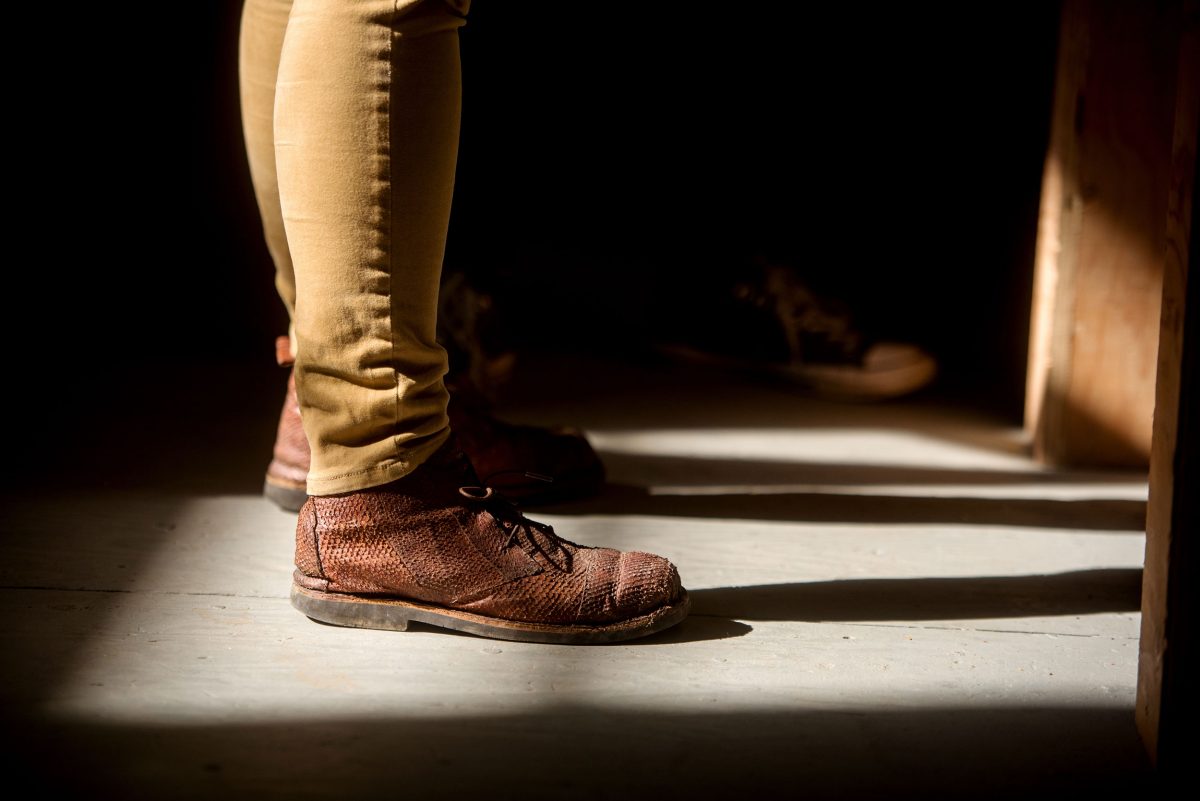
Tasha Nathanson wears the fish skin leather shoes she made as a proof of concept for the concern she's developing chosen 7 Leagues Leather. Part of her vision is to create a social-enterprise tannery that provides training and piece of work for people who face barriers to employment. Photograph by Kathleen Hinkel
So far, luxury brands have used fish skin leather sparingly in high-end designs—Nike reportedly experimented with making running shoes out of perch leather, and a company in Germany that modifies cars released a BMW with a salmon pare–trimmed interior. Elisa Palomino, a fashion designer and educator based in London, England, notes that Prada, Christian Dior, Louis Vuitton, John Galliano, and Puma have also used fish skin leather to make clothes, shoes, and bags.
Commercial interest in fish skin leather is partly a effect of consumers' environmental and ethical concerns about the global leather supply concatenation. In recent years, snakeskin and alligator skin accept come under scrutiny. In 2018, Chanel discontinued its use of reptile leathers later fauna rights activists raised concerns most the inhumane handling of reptiles raised or hunted for their skins. The modern tanning industry is likewise known to be notoriously hard on the surround and local communities. Most conventional leather is produced using harsh chemicals, such equally chromium salts, which cause respiratory ailments and persistent skin ulcers in tannery workers. Tanneries also ofttimes dump their waste into local h2o systems, where it contaminates drinking h2o and kills aquatic life.
Making fish skin leather is a gentler procedure than making conventional leather, Nathanson says. It requires fewer harsh chemicals; if made with found-based tannins, it uses no harsh chemicals at all. This, she says, property up a sample of bark-tanned skin, "is fish pare, water, salt, and trees," plus a piddling beeswax and oil.
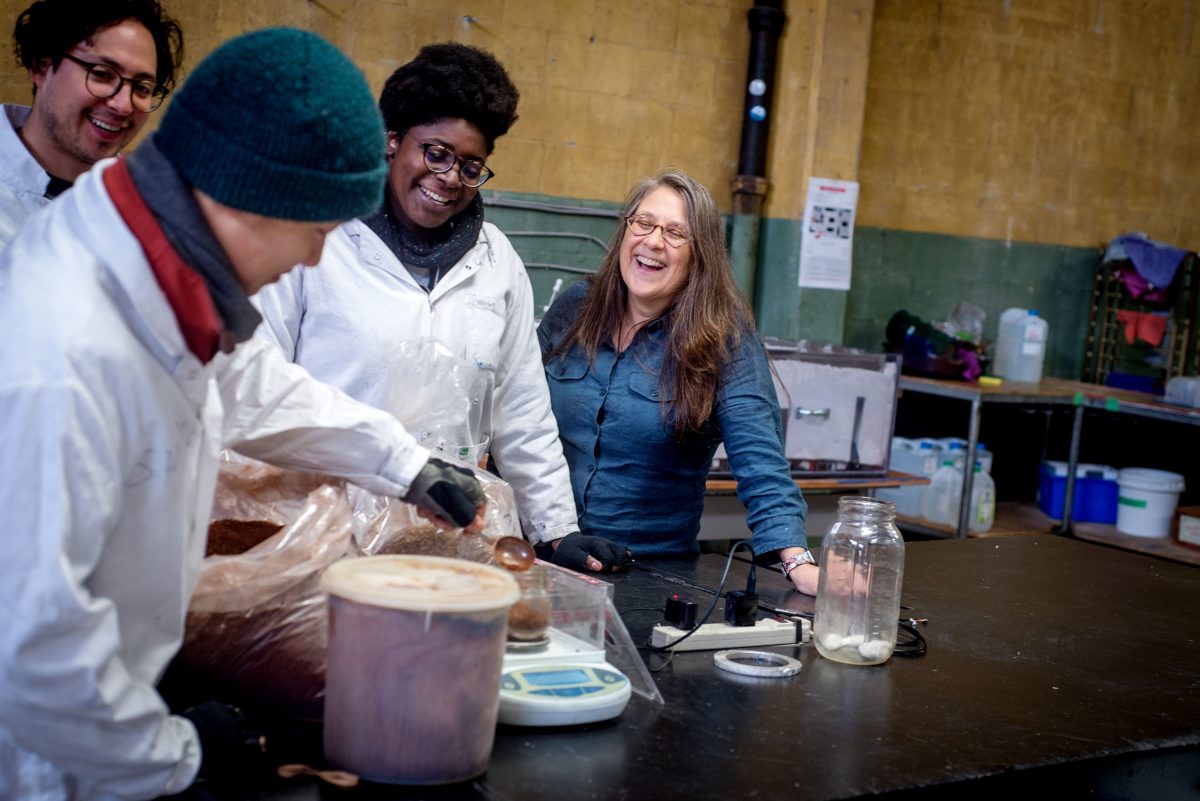
Nathanson works with a squad at Grey to Green Sustainable Solutions in Vancouver, British Columbia, a scientific consulting house that supports businesses as they develop products that utilize waste. The group is helping Nathanson research the use of local tree bark to tan her fish skins. Photograph by Kathleen Hinkel
Several sustainability-minded initiatives and companies are now pushing to develop the emerging fish skin manufacture. Under FishSkin, a inquiry projection funded by the European Union, fashion designers, scientists, museum curators, and craftspeople are meeting for preparation and networking events to observe ways of producing fish skin leather sustainably and increasing the textile'southward use in the manner industry. Similarly, the Food and Agriculture Arrangement of the United Nations (FAO) is promoting fish skin leather in its Blueish Growth initiative, a program aimed at supporting sustainable and efficient uses of ocean resources. FAO cohosted a manner show in Nairobi in 2018 that featured pieces adorned with locally crafted Nile perch leather.
Fish peel is a byproduct of the nutrient industry that often goes to waste, says Palomino, who spent 25 years working for luxury brands, such as John Galliano and Christian Dior and is involved in the FishSkin project. Every tonne of filleted fish amounts to about xl kilograms of skins, which are often footing into brute feed or fertilizer, tossed into landfills, or thrown dorsum into the ocean. Globally, humans consumed the fillets of just under 150 million tonnes of fish in 2015. That's equivalent to most six million tonnes of skins.
Nathanson was first introduced to fish pare leather past an environmental art group in Vancouver and was immediately struck by the business potential the material offered. Her goals are to create a market for fish skin leather and to arts and crafts shoes out of local, sustainably sourced materials. Her visitor will start on a smaller scale—more than boutique than mass product. She hopes to take leather prepare for sale by the end of 2020 and her shoes ready in 2021.
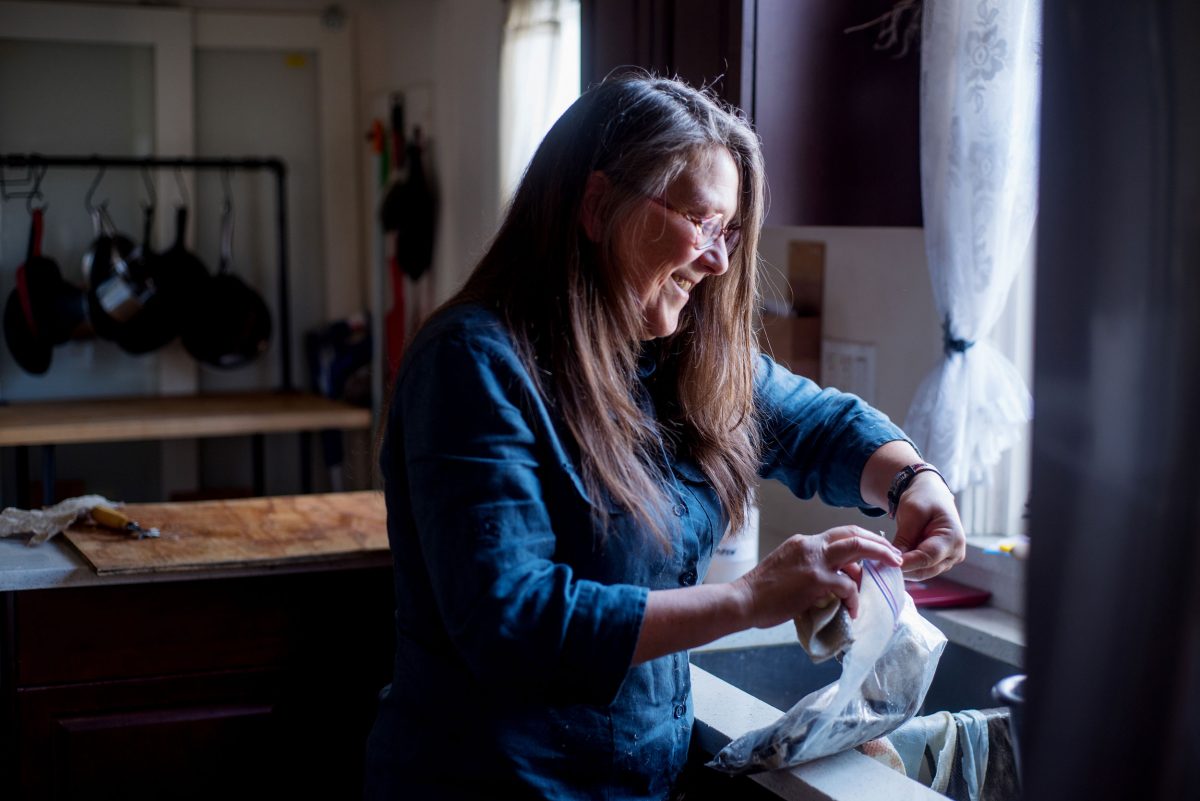
Nathanson opens a bag of fish skins to rinse in her kitchen sink in Vancouver. She regularly experiments with fish tanning techniques in her home: "This is my lab at present the way that Facebook started in a dorm room," she says. Photo by Kathleen Hinkel
Fish skin leather is sparse just remarkably strong because its fibers crisscross. Later on wearing her boots every day for six months, Nathanson was encouraged to discover that the only problems to arise were with the stitching—the thread broke—not with the leather. Now, she is working with a shoe designer and a patternmaker to create three new prototypes.
The industry, in its infancy, also faces some challenges. The thought of wearing fish pare can be off-putting to some people. The price betoken may too deter consumers—fish skin leather costs up to Tin can $516 per foursquare meter, which is roughly three and a half times more than cow leather, because it is manufactured on a much smaller scale. The leading commercial tanneries supplying fish skin leather also tend to be based in countries with high labor costs, such equally Atlantic Leather in Iceland and Nanai in Federal republic of germany.
And although tonnes of fish skins are wasted through the food industry, accessing them can be difficult. Most fish are sold peel-on, Nathanson says. For her first pair of shoes, she used skin from a local fish-smoking operation. Obtaining high-quality found-based tannins is another challenge for her; all the pre-made found-based tannin powders she has found are imported, often from Due south America. As her business develops, she plans to employ tannins derived from waste matter produced by a nearby cidery and from leftover bark from forestry operations.
Nathanson scrapes a halibut peel in her kitchen before tanning it. Photograph by Kathleen Hinkel
So far, reactions to her idea have been positive. The forestry sector and local fisheries seem interested in making more out of what currently goes unused, Nathanson says. And when Nathanson wore her fish skin shoes around Vancouver, strangers stooped down to touch them, intrigued. The fabric speaks to locals. "It is of this place."
In a time of environmental crises, using local resources to their total extent may be an thought worth reviving.
Back at Williams's home in North Vancouver, I flick the final of the scales off the salmon skin. The television hums in the background, where two of Williams'southward children, aged 15 and 8, her sister, and her niece are watching their evening programs.
The revival of fish pare leather is more than the rediscovery of a craft. Working with our hands in traditional ways is one of the few avenues we have to connect with our ancestors, Chang says. According to Williams, the process of making fish skin leather gives Indigenous peoples an opportunity to connect with their heritage in a meaningful style. Only anyone can do good from learning to make fish skin leather, she says. It enables us to restore a relationship to land and h2o. Any skill that teaches the states to slow down and respect our surroundings is a valuable one.
When I cease scraping, Williams tells me to take the peel home to finish the tanning and softening on my own. She puts it in a plastic bag and easily it to me. I identify the handbag in my backpack, unsure about my aptitude equally a tanner. Making fish skin leather is a process of learning from mistakes, Williams says. "You just proceed trying." There's always an opportunity to acquire more about the craft and the lessons it has to teach.
Source: https://hakaimagazine.com/features/the-art-of-turning-fish-into-leather/
0 Response to "Handmade Hard Leather Black Bag With Tan Lace Like They Make in High School Art Classes"
Post a Comment