The Salary for a Veterinary What Are Beef

A veterinarian conducts a surgery on a domestic true cat.
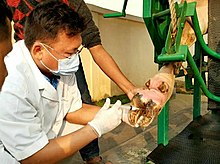
Bovine hoof health management by a Veterinary
A veterinary (vet), also known equally a veterinarian surgeon or veterinary physician, is a medical professional who practices veterinarian medicine. They manage a broad range of wellness conditions and injuries in non-homo animals. Along with this, vets also play vital role in animal reproduction, animal health management, conservation, husbandry and breeding and preventive medicine like creature diet, vaccination and parasitic control as well as bio security and zoonotic disease surveillance and prevention.
Description [edit]
In many countries, the local nomenclature for a veterinarian is a regulated and protected term, meaning that members of the public without the prerequisite qualifications and/or licensure are not able to employ the title. This championship is selective in order to produce the almost knowledgeable veterinarians that pass these qualifications. In many cases, the activities that may be undertaken by a veterinarian (such as treatment of illness or surgery in animals) are restricted only to those professionals who are registered every bit a veterinarian. For instance, in the United Kingdom, as in other jurisdictions, animal handling may only be performed by registered veterinarian physicians (with a few designated exceptions, such every bit paraveterinary workers), and it is illegal for any person who is not registered to telephone call themselves a veterinarian, prescribe any drugs, or perform treatment.
Most veterinary physicians work in clinical settings, treating animals directly. These veterinarians may be involved in a general do, treating animals of all types; they may be specialized in a specific group of animals such as companion animals, livestock, zoo animals or equines; or may specialize in a narrow medical discipline such as surgery, dermatology or internal medicine . Equally with other healthcare professionals, veterinarians face ethical decisions nearly the care of their patients.[1] Electric current debates within the profession include the ethics of certain procedures believed to be purely cosmetic or unnecessary for behavioral issues, such as declawing of cats, docking of tails, cropping of ears and debarking on dogs.[2]
Etymology and nomenclature [edit]
The give-and-take "veterinary" comes from the Latin veterinae meaning "working animals". "Veterinarian" was first used in print by Thomas Browne in 1646.[3] Although "vet" is commonly used every bit an abbreviation in all English-speaking countries, the occupation is formally referred to every bit a veterinary surgeon in the Great britain and Republic of ireland and now as a veterinarian in most of the rest of the English-speaking world.
History [edit]

Ancient Indian sage and veterinarian physician Shalihotra (mythological estimate c. 2350 BCE), the son of a sage, Hayagosha, is considered the founder of veterinary sciences.[4]

The first veterinary higher was founded in Lyon, France, in 1762 by Claude Bourgelat.[5] According to Lupton, after observing the devastation existence acquired by cattle plague to the French herds, Bourgelat devoted his fourth dimension to seeking out a remedy. This resulted in his founding a veterinary college in Lyon in 1761, from which institution he dispatched students to combat the disease; in a short time, the plague was stayed and the health of stock restored, through the help rendered to agriculture by veterinary science and fine art.[6]

The Odiham Agricultural Social club was founded in 1783 in England to promote agronomics and manufacture,[7] and played an important office in the foundation of the veterinary profession in Britain.[8] A 1785 Club meeting resolved to "promote the study of Farriery upon rational scientific principles."
The professionalization of the veterinary trade was finally achieved in 1790, through the campaigning of Granville Penn, who persuaded the Frenchman Benoit Vial de St. Bel to accept the professorship of the newly established Veterinary College in London.[vii] The Regal College of Veterinary Surgeons was established past regal charter in 1844.
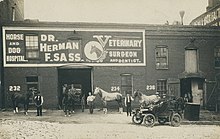
Dr. Herman F. Sass, Veterinary Surgeon, Toledo, Ohio, approximately 1911
Veterinarian science came of age in the late 19th century, with notable contributions from Sir John McFadyean, credited past many every bit having been the founder of modern Veterinary research.[9]
Roles and responsibilities [edit]

Veterinarian performing an intradermal examination for allergy in a dog (2006)
Veterinarians treat disease, disorder or injury in animals, which includes diagnosis, handling and aftercare. The scope of exercise, specialty and feel of the individual veterinary volition dictate exactly what interventions they perform, only near will perform surgery (of differing complexity).
Unlike in human medicine, veterinarians must rely primarily on clinical signs, equally animals are unable to vocalize symptoms as a human being would. In some cases, owners may be able to provide a medical history and the veterinarian can combine this information along with observations, and the results of pertinent diagnostic tests such as radiography, CT scans, MRI, blood tests, urinalysis and others.
Veterinarians must consider the appropriateness of euthanasia ("putting to sleep") if a condition is likely to get out the brute in pain or with a poor quality of life, or if treatment of a condition is probable to crusade more impairment to the patient than skillful, or if the patient is unlikely to survive any treatment regimen. Additionally, there are scenarios where euthanasia is considered due to the constrains of the customer's finances.
As with human medicine, much veterinary work is concerned with prophylactic handling, in order to prevent problems occurring in the futurity. Common interventions include vaccination against common animate being illnesses, such as distemper or rabies, and dental prophylaxis to prevent or inhibit dental disease. This may too involve owner education so as to avoid future medical or behavioral bug.
Additionally veterinarians have of import roles in public wellness and the prevention of zoonoses.[ten]
Employment [edit]
The majority of veterinarians are employed in private practice treating animals (75% of vets in the Us, according to the American Veterinary Medical Association).[eleven]
Small animal veterinarians typically piece of work in veterinary clinics, veterinary hospitals, or both. Large animate being veterinarians oftentimes spend more than time travelling to see their patients at the principal facilities which business firm them, such every bit zoos or farms.
Other employers include charities treating animals, colleges of veterinary medicine, research laboratories, animal food companies, and pharmaceutical companies. In many countries, the regime may as well exist a major employer of veterinarians, such equally the United States Department of Agronomics or the Creature and Plant Health Agency in the United Kingdom. State and local governments likewise employ veterinarians.[12] [xiii]
Focus of practice [edit]
Veterinarians and their practices may be specialized in certain areas of veterinary medicine. Areas of focus include:
- Exotic fauna veterinarian – Specializes in treating animals other than mutual pets and livestock. Includes reptiles, exotic birds such as parrots and cockatoos, and small mammals such as ferrets, rabbits, and chinchillas.[14] [15]
- Conservation medicine – The study of the relationship between animal and homo health and environmental data.
- Small animate being do – Usually dogs, cats, and other companion animals/household pets such as hamsters and gerbils. Some practices are canine-only or feline-only practices.
- Laboratory animal practice – Some veterinarians work in a university or industrial laboratory and are responsible for the care and treatment of laboratory animals of any species (often involving bovines, porcine species, felines, canines, rodents, and even exotic animals). Their responsibility is not only for the health and well-existence of the animals, but also for enforcing humane and ethical treatment of the animals in the facility.
- Large animal practice – Usually referring to veterinarians that work with, variously, livestock and other big farm animals, besides as equine species and big reptiles.
- Equine medicine – Some veterinarians are specialists in equine medicine. Horses are dissimilar in anatomy, physiology, pathology, pharmacology, and husbandry to other domestic species. Specialization in equine veterinary practice is something that is normally developed after qualification, even if students do take some interest before graduation.
- Food supply medicine – Some veterinarians deal exclusively or primarily with animals raised for nutrient (such as meat, milk, and eggs). Livestock practitioners may deal with ovine (sheep), bovine (cattle) and porcine (swine) species; such veterinarians deal with management of herds, nutrition, reproduction, and modest field surgery. Dairy medicine practice focuses on dairy animals. Poultry medicine practice focuses on the health of flocks of poultry; the field frequently involves extensive training in pathology, epidemiology, and nutrition of birds. The veterinarian treats the flock and non the individual animals.[sixteen]
- Food safety practice – Veterinarians are employed by both the food industry and government agencies to suggest on and monitor the handling, preparation, and storage of food in means that forbid foodborne affliction.
- Wildlife medicine – A relatively recent branch of veterinary medicine, focusing on wildlife. Wildlife medicine veterinarians may work with zoologists and conservation medicine practitioners and may also be chosen out to treat marine species such every bit ocean otters, dolphins, or whales after a natural disaster or oil spill.
- Aquatic medicine – mostly refers to veterinary intendance of fish in aquaculture (like salmon, cod, among other species), but tin can also include care of aquatic mammals. For certain countries with high economic income from aquaculture, this is an important part of the veterinary field (like Norway, Chile). Other countries (particularly those who are landlocked), might have little or no emphasis on aquatic medicine.
- Dentistry – Many practices are incorporating dentistry into their daily medical services. Veterinary dentistry tin extend the life of the patient past preventing oral affliction and keeping the teeth and gums of the patient in healthy condition.
Veterinary specialties [edit]
Veterinarian specialists are in the minority compared to general exercise veterinarians, and tend to be based at points of referral, such equally veterinary schools or larger animate being hospitals. Unlike homo medicine, veterinary specialties often combine both the surgical and medical aspects of a biological system.
Veterinarian specialties are accredited in N America by the AVMA through the American Board of Veterinary Specialties, in Europe by the European Board of Veterinary Specialisation and in Australasia by the Australasian Veterinary Boards Council. While some veterinarians may take areas of interest outside of recognized specialties, they are not legally specialists.
Specialties tin can encompass general topics such every bit anesthesiology, dentistry, and surgery, as well equally organ system focus such as cardiology or dermatology. A full listing can be seen at veterinary specialties.
Mobile practise [edit]
Many veterinarians, specially in large animate being exercise, offer house calls and farm calls through a mobile practice. The start-upwardly and operating costs of a mobile exercise are typically lower than those of a traditional brick and mortar infirmary, which can cost millions of dollars or more than for equipment and surgical supplies. Costs associated with mobile units can range from as low as $5,000 for a utility box in an SUV to effectually $250,000 for a fully equipped custom built chassis.[17] The potential advantages to the client are non having to ship the animal, lower stress for the animal, a lower take chances of disease transmission from other animals, and convenience. A 2015 study published in the Journal of American Veterinary Medical Clan proved that blood force per unit area readings, pulse rates and body temperature rates were increased past 11–16% when those readings were done in the clinic versus in the dwelling house.[18] However, mobile practices often lack the facilities and equipment to provide advanced care, surgery, or hospitalization. Some mobile practices maintain a relationship with a traditional hospital for referral of cases needing more comprehensive intendance.
Bacon [edit]
The concluding AVMA Report on Veterinarian Compensation, published in 2018, indicated private practise associate veterinarians who had lath certification earned a mean of $187,000. A veterinary's bacon tin hands exceed $300,000 depending on the specialty. The median starting salary for new veterinary graduates without specialization in 2018 was $103,800 in the United States co-ordinate to the Bureau of Labor Statistics, while the everyman paid earned less than $89,540 annually.[nineteen] States and districts with the highest mean salary are California ($398,340), Michigan ($325,100), Illinois ($324,870), New York ($322,500), and Hawaii ($221,150).[20] Veterinarians who own their ain clinics are typically paid a much higher bacon. The average owner payout is $400,000 for every $1,000,000 of clinic income. In 2021 there were practices sold with $8-10,000,000 in yearly acquirement with the owners cartoon salaries of several million dollars. Over 90% of practice owners do non regret purchasing or starting their own practice, according to a 2020 survey of dispensary owners.
Educational activity and regulation [edit]

Veterinary students learning the dental handling of a equus caballus.
In social club to practice, vets must complete an appropriate caste in veterinary medicine, and in most cases must also be registered with the relevant governing body for their jurisdiction.
Veterinary science degrees [edit]
Degrees in veterinarian medicine culminate in the award of a veterinarian science degree, although the title varies past region. For example, in North America, graduates will receive a Dr. of Veterinary Medicine (Dr. of Veterinary Medicine or Veterinariae Medicinae Doctoris; DVM or VMD), whereas in the United kingdom of great britain and northern ireland, Australia, New Zealand or India they would be awarded a Available of Veterinary Science, Surgery or Medicine (BVS, BVSc, BVetMed or BVMS), and in Republic of ireland graduates receive a Medicinae Veterinariae Baccalaureus (MVB). In continental Europe, the caste of Doctor Medicinae Veterinariae (DMV, DrMedVet, Dr. med. vet., MVDr.) or Doctor Veterinariae Medicinae (DVM, DrVetMed, Dr. vet. med.) is granted.[21]
The award of a bachelor's caste was previously commonplace in the The states, simply the caste name and bookish standards were upgraded to match the 'doctor' title used by graduates.
Comparatively few universities have veterinarian schools that offering degrees which are accredited to authorize the graduates as registered vets. For instance, at that place are 30 in the United states, v in Canada, 1 in New Zealand, seven in Australia (4 of which offer degrees accredited by the American Veterinary Medical Association (AVMA)), and eight in the United Kingdom (4 of which offer degrees accredited by the American Veterinary Medical Association (AVMA)).[22]
Due to this scarcity of places for veterinary degrees, admission to veterinary school is competitive and requires all-encompassing grooming. In the U.s. in 2007, approximately 5,750 applicants competed for the 2,650 seats in the 28 accredited veterinarian schools, with an acceptance rate of 46%.[23]
With competitive admission, many schools may place heavy accent and consideration on a candidate's veterinary and animal experience. Formal feel is a particular reward to the applicant, ofttimes consisting of work with veterinarians or scientists in clinics, agribusiness, research, or some area of health scientific discipline. Less formal experience is also helpful for the applicant to have, and this includes working with animals on a farm or ranch or at a stable or beast shelter and basic overall animal exposure.[24]
In the Usa, approximately lxxx% of admitted students are female. In the early history of veterinary medicine of the United States, nigh veterinarians were males. Still, in the 1990s this ratio reached parity, and now it has been reversed.
Preveterinary courses should emphasize the sciences. Virtually veterinary schools typically require applicants to have taken one year equivalent classes in organic, inorganic chemical science, physics, full general biology; and one semester of vertebrate embryology and biochemistry. Ordinarily, the minimal mathematics requirement is college level calculus. Private schools might require introduction to animal science, livestock judging, animal diet, cell biology, and genetics. Withal, due to the limited availability of these courses, many schools have removed these requirements to widen the puddle of possible applicants.
Registration and licensing [edit]
Following academic education, near countries require a vet to be registered with the relevant governing torso, and to maintain this license to practice.
According to the Agency of Labor Statistics, veterinarians must be licensed to practice in the United States.[25] Licensing entails passing an accredited program, a national exam, and a country exam. For example, in the United states, a prospective vet must receive a passing grade on a national board examination, the N America Veterinary Licensing Examination. This exam must be completed over the course of eight hours, and consists of 360 multiple-selection questions, covering all aspects of veterinary medicine, as well as visual material designed to exam diagnostic skills.
Postgraduate report [edit]
The per centum electing to undertake further study post-obit registration in the United States has increased from 36.eight% to 39.ix% in 2008. About 25% of those or nigh ix% of graduates were accepted into traditional bookish internships. Approximately 9% of veterinarians eventually board certify in one of twoscore distinct specialties from 22[26] specialty organizations recognized by the AVMA American Board of Veterinary Specialties (ABVS).[27] [28]
ABVS recognized veterinary specialties [edit]
Source:[29]
| Anesthesiology and analgesia | Animal welfare | Avian practice |
| Bacteriology and mycology | Beef cattle practice | Beliefs |
| Canine and feline medicine | Cardiology | Dairy exercise |
| Dentistry | Dermatology | Exotic animal medicine |
| Emergency and critical care | Equine medicine | Epidemiology |
| Laboratory animal medicine | Orthopaedics | Internal medicine |
| Pathology | Pharmacology | Poultry medicine |
| Reproductive medicine | Radiation oncology | Radiology |
| Shelter medicine | Surgery | Swine wellness direction |
| Toxicology | Virology | Zoological medicine |
Curriculum comparison with human being medicine [edit]
The first two-year curriculum in both veterinarian and human medical schools are very like in grade names, simply in sure subjects are relatively different in content. Considering the courses, the starting time two-year curriculum usually includes biochemistry, physiology, histology, anatomy, pharmacology, microbiology, epidemiology, pathology and hematology.[30]
Some veterinary schools utilize the aforementioned biochemistry, histology, and microbiology books as homo medicine students; notwithstanding, the class content is greatly supplemented to include the varied animate being diseases and species differences. In the past, many veterinarians were trained in pharmacology using the same text books used by human being physicians. Every bit the specialty of veterinary pharmacology has developed, more schools are using pharmacology textbooks written specifically for veterinarians. Veterinary physiology, beefcake, and histology is complex, as physiology often varies among species. Microbiology and virology of animals share the aforementioned foundation as human microbiology, but with grossly dissimilar disease manifestation and presentations. Epidemiology is focused on herd health and prevention of herd borne diseases and strange animal diseases. Pathology, like microbiology and histology, is very diverse and encompasses many species and organ systems. Most veterinary schools accept courses in small animal and large brute nutrition, oftentimes taken as electives in the clinical years or equally part of the core curriculum in the first two years.
The concluding ii-year curriculum is like to that of homo medicine only in clinical emphasis.[thirty] A veterinary educatee must be well prepared to be a fully functional creature doc on the 24-hour interval of graduation, competent in both surgery and medicine. The graduating veterinary must be able to pass medical board examination and be prepared to enter clinical do on the twenty-four hour period of graduation, while most human medical doctors in the The states consummate 3 to v years of post-doctoral residency before practicing medicine independently, usually in a very narrow and focused specialty. Many veterinarians practice also complete a post-doctoral residency, but it is not nearly every bit common equally it is in human medicine.
In the terminal years, curricula in both homo and veterinarian medicine take been adapted with the aim of incorporating competency-based educational activity.[31] [32] Furthermore, the importance of institutionalized systematic instructor feedback has been recognized and tools such every bit clinical see cards are existence implemented in clinical veterinary didactics.[33]
Impact on human medicine [edit]
Some veterinarians pursue post-graduate preparation and enter research careers and have contributed to advances in many human and veterinary medical fields, including pharmacology and epidemiology. Research veterinarians were the starting time to isolate oncoviruses, Salmonella species, Brucella species, and various other pathogenic agents. Veterinarians were in the forefront in the effort to suppress malaria and yellow fever in the United States. Veterinarians identified the botulism disease-causing amanuensis, developed a widely used anesthetic induction drug,[34] produced an anticoagulant used to care for human heart disease,[35] and developed surgical techniques for humans, such equally hip-joint replacement, limb and organ transplants.
Occupational hazards [edit]
Veterinarians work with a wide variety of animal species typically in hospitals, clinics, labs, farms, and zoos.[36] Veterinarians face many occupational hazards including zoonotic diseases, bites and scratches, hazardous drugs, needlestick injuries, ionizing radiation, and dissonance.[37] [38] [39] According to the U.S. Section of Labor, 12% of workers in the veterinary services profession reported a work-related injury or affliction in 2016.[40] Needlestick injuries are the most common accidents among veterinarians, but they are likely underreported.[40] [41] [42] Needlesticks can issue in hazardous drug or bloodborne-pathogen exposures. Unlike human medical professionals, veterinarians receive minimal training on safe handling of hazardous drugs in schoolhouse.[43] As well, a large percentage of veterinarians are women of reproductive age and drug exposures put them at risk of infertility or other adverse health outcomes.[43] [44] Additionally, some antibiotics, steroids, and chemotherapy drugs are known to have negative effects on male fertility.[45] The U.S. National Institute for Occupational Safe and Health has issued guidance on the safe handling of hazardous drugs for veterinary workers.[46] Creature bites and scratches are another common injury in veterinary practice.[38] The shut interactions with animals put veterinarians at increased gamble of contracting zoonoses. A systematic review of veterinary students establish that between 17 – 64% had acquired a zoonotic disease during their studies.[37] The beast species, work setting, health and condom practices, and training can all affect the chance of injury and illness.[37]
Veterinary practices need a health and safety program that addresses infection prevention and other hazards.[39] [41] Noise tin can be a prominent exposure, in which example a hearing loss prevention plan may exist recommended. A NIOSH written report on kennel noise found that dissonance levels often exceeded OSHA's permissible exposure limit.[47] Reducing dissonance is benign for animal and human being health.[48] [49] Workplaces should utilize engineering science controls, administrative controls, and personal protective equipment to keep their employees safe.[41] [39] PPE such every bit gloves, safety goggles, lab coats, and hearing protection should be readily available with mandatory grooming on proper usage. Raising awareness is the most of import pace in promoting workplace wellness and rubber.[40]
Veterinarians have high suicide rates in comparison to the general population.[50] A written report past the U.Southward. Centers for Disease Command and Prevention found that male veterinarians are 2.1 times and female veterinarians are 3.5 times as likely as the general population to die by suicide.[l] Some reasons for this could be long hours, work overload, customer expectations and complaints, poor remuneration, euthanasia procedures, and poor piece of work-life balance.[50] A survey of more than than 11,000 vets found 9% had serious psychological distress, 31% experienced depressive episodes, and 17% had suicidal ideation.[51] Online support groups, such as Non One More Vet, take been established to assistance veterinarians who may be experiencing suicidal thoughts.[52] Some other driver of stress can be pupil loan debt. A 2013 national survey plant that average debt for veterinarian medicine graduates was as loftier as $162,113.[53] Veterinarian lifelong earning potential is less than a physician, and so it can have a lot longer to break even.[53]
The COVID-19 pandemic has created a greater demand for veterinarian services.[54] Many people are dwelling house with extra time on their hands, and adoption agencies and animals shelters have seen a surge in pet purchases every bit a issue.[54] The American Veterinary Medical Association has provided COVID-19 resources for veterinarians on prevention measures, animal testing, and wellbeing.[55]
In pop culture [edit]
Reality televisions shows featuring veterinarians include:
- Bondi Vet, an Australian factual telly series. Information technology follows the lives of veterinary surgeon Chris Brownish at the Bondi Junction Veterinary Hospital.
- The Incredible Dr. Political leader, a Us veterinary reality show. Produced by National Geographic Wild, a Disney aqueduct. It follows the life of Dr. January Pol and Politician Veterinarian Service in Michigan.
- E-Vet Interns (1998–2002), a US testify filmed at Alameda East Veterinarian Infirmary in Denver, Colorado.
- Emergency Vets, filmed at Alameda Due east Veterinary Hospital in Denver, Colorado.
- Rookie Vets (2005), featuring students at Massey University in New Zealand.
- Vet School Confidential (2001), post-obit students at Michigan State University College of Veterinary Medicine in the U.s.a..
- Vets in Practice (1997–2002), a British series.
Fictional works featuring a veterinarian equally the main protagonist include:
- James Herriot'southward series of books containing fictionalized stories of his career equally a farm animate being veterinary in England, which was adapted as the BBC telly series All Creatures Great and Small.[56]
- The 3 Lives of Thomasina almost Andrew MacDhui, a veterinarian in a village in Scotland.
- The Doctor Dolittle serial of children's books, which have twice been adjusted into movies, Physician Dolittle (1967), Dr. Dolittle (1998), and Dolittle (2020).
- The film Beethoven, featuring the evil veterinarian Dr. Herman Varnick.
Veterinary malpractice [edit]
Nigh states in the The states allow for malpractice lawsuit in case of death or injury to an animal from professional negligence. Commonly the punishment is non greater than the value of the animal. Some states let for castigating penalty, loss of companionship, and suffering, likely increasing the cost of veterinary malpractice insurance and the cost of veterinary care. Most veterinarians carry business, worker's bounty, and facility insurance to protect their clients and workers from injury inflicted past animals.[ citation needed ]
See also [edit]
- Veterinary medicine in the United Kingdom
- Veterinary medicine in the United States
References [edit]
- ^ Rollin, Bernard East. (October 2009). "Ideals and euthanasia". The Canadian Veterinarian Journal. fifty (ten): 1081–1086. ISSN 0008-5286. PMC2748292. PMID 20046609.
- ^ "WSAVA Animal Welfare Guidelines" (PDF). World Small Animate being Veterinary Association. 2018.
- ^ Oxford English Dictionary, Oxford University Printing.
- ^ "M.K. Singh and R.S. Chauhan, "History of Veterinarian Anatomy," Indian Clan of Veterinary Anatomists". o-f.com. Archived from the original on 26 Dec 2005. Retrieved 6 May 2018.
- ^ Marc Mammerickx, Claude Bourgelat: avocat des vétérinaires, Bruxelles 1971.
- ^ J.L.Lupton, "Modern Practical Farriery", 1879, in the department: "The Diseases of Cattle Sheep and Pigs" pp. 1
- ^ a b Pugh, Fifty.P (1962). From Farriery to Veterinarian Medicine 1785–1795. Heffner, Cambridge (for RCVS). pp. 8–xix.
- ^ Cotchen, Ernest (1990). The Royal Veterinary College London, A Bicentenary History. Barracuda Books Ltd. pp. 11–thirteen.
- ^ "Exacting researcher brought profession into modern age". American Veterinary Medical Clan. Archived from the original on 23 July 2017.
- ^ Stöhr K, Meslin FX (1997). "The role of veterinary public health in the prevention of zoonoses". Arch. Virol. Suppl. 13: 207–18. doi:10.1007/978-iii-7091-6534-8_20. ISBN978-three-211-83014-seven. PMID 9413540.
- ^ "Market Research Statistics: U.Due south. Veterinarians 2017". world wide web.avma.org. Archived from the original on 24 December 2017. Retrieved 6 May 2018.
- ^ "Veterinarians : Occupational Outlook Handbook : U.S. Bureau of Labor Statistics". Bls.gov. 26 April 2012. Archived from the original on 17 Jan 2012. Retrieved 5 July 2013.
- ^ "Veterinarians". goarmy.com. Archived from the original on 11 May 2009. Retrieved 5 July 2013.
- ^ "The Clan of Exotic Mammal Veterinarians | AEMV". Association of Exotic Mammal Veterinarians. 21 March 2018. Retrieved 5 May 2021.
- ^ "Clan of Reptilian and Amphibian Veterinarians | ARAV Membership". ARAV . Retrieved five May 2021.
- ^ "What is Nutrient Supply Veterinary Medicine (FSVM)". American Veterinarian Medical Association. 2019.
- ^ Tiffany, Lynn 1000. "Mobile Vets are Driven to Succeed". Veterinarian Practice News. ix Jun 2011."Mobile Vets Are Driven to Succeed". ix June 2011. Archived from the original on 20 December 2016. Retrieved 5 December 2016.
- ^ Bragg, Ryan F., et al. "Evaluation of the effects of hospital visit stress on physiologic variables in dogs". Journal of the American Veterinarian Medical Association. fifteen Jan 2015. Web. 26 November 2016 [1]
- ^ Cima, Greg (26 September 2018). "Specialists in brusque supply". American Veterinary Medical Association.
- ^ "Veterinarian Salary". U.Southward. News Best Jobs Rankings.
- ^ "Veterinary Medical Degrees Granted Throughout the Globe". Retrieved 28 Baronial 2019.
- ^ "Accredited Veterinary Colleges". AVMA. American Veterinarian Medical Association. Retrieved 4 July 2020.
- ^ Griel, Lester C. "Advising Notes." Partitioning of Undergraduate Studies. vii Apr. 2008. The Pennsylvania State University. ii Mar. 2009 <"Archived copy". Archived from the original on 27 May 2010. Retrieved 3 Baronial 2010.
{{cite web}}: CS1 maint: archived re-create every bit title (link)>. - ^ Dr. Kendon, Evan B.Five.Sc "Vets And Pets" <"Christchurch Pet Vet | Christchurch Mobile Vet". Archived from the original on 28 Oct 2014. Retrieved 28 Oct 2014. >
- ^ "Veterinarians : Occupational Outlook Handbook: : U.S. Bureau of Labor Statistics". world wide web.bls.gov . Retrieved 28 August 2019.
- ^ "American Board of Veterinary Specialties". AVMA. American Veterinary Medical Association. Archived from the original on 22 Dec 2015. Retrieved 12 Dec 2015.
- ^ "Marketplace research statistics". AVMA. Archived from the original on 6 October 2012.
- ^ "Recognized Veterinarian Specialty Organizations". AVMA. Archived from the original on 1 May 2006.
- ^ "ABVS – Recognized Veterinarian Specialty Organizations". AVMA.org. American Veterinary Medical Association. Archived from the original on 17 December 2016. Retrieved 12 December 2015.
- ^ a b "DVM Curriculum – College of Veterinarian Medicine at Michigan State University". Cvm.msu.edu. 7 December 2009. Archived from the original on 23 June 2013. Retrieved 5 July 2013.
- ^ Burger, C.; Pirker, M.; Bergsmann, East.Yard.; Winter, P. (2015). "[Quality management in competence-oriented teaching: Theory and practice at the Vetmeduni Vienna] Qualitätsmanagement in der kompetenzorientierten Lehre: Theorie und Praxis an der Veterinärmedizinischen Universität Wien". In Vettori, Oliver; Salmhofer, Gudrun; Mitterauer, Lukas; Ledermüller, Karl (eds.). Eine Frage der Wirksamkeit? Qualitätsmanagement als Impulsgeber für Veränderungen an Hochschulen [A question of effectiveness? Quality direction as innovation generator for changes at universities] (in German language). Bielefeld, Frg: UniversitätsVerlagWebler. pp. 145–160. ISBN978-iii-946017-00-four.
- ^ Bergsmann, Evelyn; Klug, Julia; Burger, Christoph; Först, Nora; Spiel, Christiane (2017). "The Competence Screening Questionnaire for Higher Education: Adaptable to the needs of a written report programme". Assessment & Evaluation in Higher Didactics. 43 (4): 537–554. doi:10.1080/02602938.2017.1378617. S2CID 148700628.
- ^ Buchner, H.H. Florian; Nawrocik, Daniel; Burger, Christoph (1 February 2018). "Pupil-Initiated Feedback Using Clinical Encounter Cards during Clinical Rotations in Veterinary Medicine: A Feasibility Written report". Journal of Veterinary Medical Didactics. 45 (1): 76–84. doi:x.3138/jvme.0316-073r. PMID 28657483.
- ^ Sample, Ian (eleven September 2018). "British vet wins peak research award for quantum anaesthetic". The Guardian . Retrieved 24 June 2021.
- ^ Lim, Gregory (2017). "Warfarin: from rat poinson to clinical use". Nature Reviews Cardiology. doi:10.1038/nrcardio.2017.172. PMID 29238065. Retrieved 24 June 2021.
- ^ "Veterinarians : Occupational Outlook Handbook: : U.S. Bureau of Labor Statistics". www.bls.gov . Retrieved 10 August 2020.
- ^ a b c Sánchez, Antonio; Prats-van der Ham, Miranda; Tatay-Dualde, Juan; Paterna, Ana; de la Iron, Christian; Gómez-Martín, Ángel; Corrales, Juan C.; Contreras, Antonio (4 Jan 2017). Cloeckaert, Axel (ed.). "Zoonoses in Veterinary Students: A Systematic Review of the Literature". PLOS One. 12 (1): e0169534. Bibcode:2017PLoSO..1269534S. doi:ten.1371/journal.pone.0169534. ISSN 1932-6203. PMC5215727. PMID 28052113.
- ^ a b Epp, T., & Waldner, C. (2012). Occupational health hazards in veterinary medicine: zoonoses and other biological hazards. The Canadian veterinary journal = La revue veterinaire canadienne, 53(2), 144-150.
- ^ a b c "Veterinary Rubber & Health - Hazard Prevention and Infection Control | NIOSH | CDC". www.cdc.gov. 24 Feb 2020. Retrieved 10 August 2020.
- ^ a b c McReynolds, Tony (15 August 2019). "Us Department of Labor: Working in the veterinary field is more dangerous than working in law enforcement". American Fauna Hospital Association . Retrieved 10 Baronial 2020.
- ^ a b c Scheftel, Joni M.; Elchos, Brigid Fifty.; Cherry, Bryan; DeBess, Emilio Due east.; Hopkins, Sharon Thou.; Levine, Jay F.; Williams, Carl J.; Bell, Michael R.; Dvorak, Glenda D.; Funk, Renee H.; Only, Steven D. (15 December 2010). "Compendium of Veterinarian Standard Precautions for Zoonotic Disease Prevention in Veterinary Personnel: National Clan of State Public Health Veterinarians Veterinary Infection Command Committee 2010". Journal of the American Veterinary Medical Clan. 237 (12): 1403–1422. doi:10.2460/javma.237.12.1403. ISSN 0003-1488. PMID 21155680.
- ^ Fowler, Heather N.; Holzbauer, Stacy One thousand.; Smith, Kirk E.; Scheftel, Joni M. (fifteen January 2016). "Survey of occupational hazards in Minnesota veterinary practices in 2012". Journal of the American Veterinary Medical Association. 248 (2): 207–218. doi:10.2460/javma.248.2.207. ISSN 0003-1488. PMC5710733. PMID 26720089.
- ^ a b "NIOSH to help amend drug rubber in veterinary clinics". American Veterinary Medical Association . Retrieved 10 Baronial 2020.
- ^ Scheftel, Joni One thousand.; Elchos, Brigid L.; Rubin, Carol Due south.; Decker, John A. (15 April 2017). "Review of hazards to female reproductive health in veterinary practice". Journal of the American Veterinary Medical Association. 250 (8): 862–872. doi:x.2460/javma.250.8.862. ISSN 0003-1488. PMC5678953. PMID 28358639.
- ^ Cleveland Clinic. "Drugs and Male person Fertility".
- ^ "Condom handling of chancy drugs for veterinary healthcare workers" (PDF). one June 2010. doi:10.26616/nioshpub2010150.
- ^ Achutan, Chandran (May 2007). "Noise Exposures and Hearing Loss Assessments among Animate being Shelter Workers" (PDF). Centers for Disease Control and Prevention.
- ^ "Reducing Noise Helps Animal Wellness, Worker Safe". Veterinary Exercise News. 30 April 2010. Retrieved 10 August 2020.
- ^ Schäffer, D.; Marquardt, V.; Marx, G.; von Borell, East. (2001). "[Noise in creature housing--a review with special reference to pig housing]". DTW. Deutsche tierarztliche Wochenschrift. 108 (ii): 60–66. ISSN 0341-6593. PMID 11367883.
- ^ a b c Tomasi, Suzanne E.; Fechter-Leggett, Ethan D.; Edwards, Nicole T.; Reddish, Anna D.; Crosby, Alex Due east.; Nett, Randall J. (2019). "Suicide amongst veterinarians in the U.s.a. from 1979 through 2015". Journal of the American Veterinary Medical Association. 254 (1): 104–112. doi:10.2460/javma.254.1.104. ISSN 0003-1488. PMC6417412. PMID 30668293.
- ^ Nett, Randall J.; Witte, Tracy Yard.; Holzbauer, Stacy M.; Elchos, Brigid 50.; Campagnolo, Enzo R.; Musgrave, Karl J.; Carter, Kris K.; Kurkjian, Katie Chiliad.; Vanicek, Cole F.; O'Leary, Daniel R.; Pride, Kerry R. (fifteen October 2015). "Run a risk factors for suicide, attitudes toward mental illness, and do-related stressors amidst United states of america veterinarians". Journal of the American Veterinary Medical Association. 247 (eight): 945–955. doi:10.2460/javma.247.eight.945. ISSN 0003-1488. PMID 26421408.
- ^ Haugland, Rebecca (21 September 2020). "How Not One More Vet (NOMV) is Supporting Veterinary Professionals | GVL". www.globalvetlink.com.
- ^ a b Funk, Julie. "The high cost of pursuing a dream to be a veterinarian". The Conversation . Retrieved 10 August 2020.
- ^ a b Tan, Jean-Yin. "Puppies & exhaustion: The economic bear on of the coronavirus on vets". The Conversation . Retrieved 10 August 2020.
- ^ "COVID-19". American Veterinary Medical Association . Retrieved 10 August 2020.
- ^ "His Works". James Herriot.org. James Herriot.org. Archived from the original on 22 Dec 2015. Retrieved 12 December 2015.
Further reading [edit]
- Freyberger, P. (2009). Vetting: The Making of a Veterinarian. PJF Publishing.
- Herriot, James (2004)[1972]. All Creatures Smashing and Modest. St. Martin's Griffin.
External links [edit]
- Veterinarian at Curlie
- NIOSH guidance for Veterinary Safety and Health
- European Agency for Prophylactic and Health at Work
Source: https://en.wikipedia.org/wiki/Veterinarian
0 Response to "The Salary for a Veterinary What Are Beef"
Post a Comment